
What Is Query Context?
Query context helps search engines and AI systems understand the circumstances surrounding a search. Learn how location, preferences, conversation history, and other signals can change which businesses appear.
A search is more than the words someone types.
Modern search engines and AI systems also consider the context surrounding the query to better understand what the person actually needs.
That surrounding information is called query context.
What is query context?
Query context is the additional information that helps a search system interpret a request.
Imagine someone searches:
“best dentist”
That phrase alone leaves several questions unanswered. Where is the person located? Are they looking for cosmetic dentistry, emergency care, or a general dentist? Are they researching options or trying to book an appointment?
Context helps narrow those possibilities.
What can create query context?
Different discovery systems can use different signals, but context may include:
Location
Previous searches or conversation
Words used in the query
Device or interface
Time and freshness
Specific requirements
The user's stated preferences
These signals help systems determine which information is most relevant to the situation.
Query context and search intent
Search intent describes what someone is trying to accomplish.
Query context helps explain the circumstances surrounding that goal.
For example, two people might both search for an HVAC company.
One is researching replacement systems.
The other has an air conditioner that stopped working tonight.
The general topic is similar, but the context changes what information is useful.
This builds directly on What Is Search Intent?
Why context matters for businesses
Businesses aren't relevant to every customer in every situation.
A plumber in Tampa may be highly relevant to someone searching nearby but useless to someone in Denver.
A restaurant open for lunch may be relevant at noon but unavailable late at night.
A company specializing in commercial projects may not fit a residential request.
Modern discovery systems attempt to account for these differences.
That means visibility isn't simply about whether a business can appear.
It is about whether the business can appear when the context makes it relevant.
Query context becomes even more important in AI search
AI conversations can contain much more context than a traditional search query.
Someone might ask:
“Find a company near me that provides this service, works with small businesses, and has experience with multi-location brands.”
The system now has several conditions to evaluate.
Follow-up questions can add even more.
That means businesses need clear information about their services, customers, locations, experience, and capabilities if they want systems to accurately determine when they fit a request.
How businesses can improve contextual relevance
Businesses should clearly communicate the facts customers use when making decisions.
That includes what the company does, where it operates, who it serves, what services it provides, and what makes it different.
Clear service pages, location information, structured business data, reviews, and consistent public information all give discovery systems stronger evidence.
The goal isn't to appear for every query.
The goal is to be clearly relevant for the right ones.
Key takeaway
Query context is the information surrounding a search that helps systems determine what the user actually needs.
Search intent explains the goal.
Context helps define the situation.
Together, they help search engines and AI systems decide which businesses, pages, and answers are most relevant.
Check your business visibility
Use the Visibility Checker to see how your business appears across modern discovery systems and where important information may be missing.
What Is Search Intent?
Search intent is the reason behind every search. Learn how search engines understand user goals, why intent matters more than keywords, and how matching content to intent improves online visibility.
Search engines have become much better at understanding why someone performs a search—not just what they type.
That purpose is called search intent.
Understanding search intent helps search engines deliver results that solve a person's problem instead of simply matching keywords.
What is search intent?
Search intent is the goal behind a search.
Someone searching "coffee near me" is probably looking for a nearby coffee shop.
Someone searching "how to brew coffee" wants instructions.
Even though both searches mention coffee, the intent is completely different.
Modern search engines analyze those differences to deliver more useful results.
The four common types of search intent
Most searches fall into one of four categories.
Informational — Learning about a topic.
Example:
What is semantic search?
Navigational — Trying to reach a specific website or business.
Example:
CXTY Limits
Commercial — Comparing products or services before making a decision.
Example:
Best visibility tools
Transactional — Ready to take action.
Example:
Business visibility checker
Each type of intent requires different search results.
Why businesses should care
Search engines want to satisfy users quickly.
If your content answers the intent behind a search, it has a better chance of being considered useful.
That doesn't mean stuffing pages with keywords.
It means creating information that genuinely answers the question someone is asking.
Search intent and AI
AI-powered search systems rely heavily on search intent.
Instead of matching words, they analyze context, meaning, and user goals before generating responses.
Businesses that publish helpful, accurate content are easier for AI systems to recommend because their information aligns with what users are actually trying to accomplish.
Matching your content to intent
Businesses can improve their visibility by creating content that matches different stages of a customer's journey.
Examples include:
Educational guides
Service pages
FAQ pages
Location pages
Product comparisons
Contact information
Each page serves a different intent.
Together, they help search engines understand that your website answers a wide variety of customer questions.
Key takeaway
Search intent focuses on why someone searches—not simply the words they use.
Businesses that create content aligned with user intent make it easier for search engines and AI systems to connect customers with the right information.
Check your business visibility
Use the Visibility Checker to see how consistently your business appears across search engines, Maps, directories, reviews, competitors, and AI-powered discovery.
What Is Semantic Search?
Semantic search helps search engines understand the meaning behind words instead of simply matching keywords. Learn how semantic search improves business discovery, search results, and AI-generated answers.
Search engines have evolved far beyond matching keywords.
Today, they try to understand what people actually mean when they search.
This approach is known as semantic search.
Instead of looking only for exact words, semantic search analyzes context, relationships, and intent to deliver results that best answer a person's question.
From keywords to meaning
Traditional search focused on matching words.
If someone searched for "pizza near me," early search engines looked for pages containing those exact words.
Modern search engines go further.
They recognize that a person is looking for nearby restaurants that serve pizza—even if those exact words don't appear together.
Understanding entities
Semantic search depends on understanding entities and how they relate to one another.
Search systems evaluate information such as:
Businesses
Products
Locations
Services
Organizations
People
These entities are connected through knowledge graphs and structured data, allowing search engines to understand relationships instead of isolated keywords.
Why businesses benefit
Businesses with clear, consistent information are easier for semantic search systems to understand.
That can improve:
Search relevance
Local discovery
AI-generated answers
Voice search
Knowledge graph connections
The goal is not simply ranking for keywords but becoming the best answer for a user's intent.
AI builds on semantic search
Modern AI search experiences rely heavily on semantic understanding.
Rather than matching individual words, AI systems evaluate meaning across multiple trusted sources before generating responses.
Businesses with accurate entity information and structured data are easier for AI to recognize and reference correctly.
Building stronger semantic signals
Businesses can strengthen semantic understanding by:
Maintaining consistent business information
Using structured data
Publishing clear service descriptions
Keeping websites updated
Removing conflicting information across the web
These practices help search engines understand not only what your business says, but what it actually is.
Key takeaway
Semantic search helps search engines understand meaning instead of simply matching words.
The stronger your business's entity signals become, the easier it is for search engines and AI systems to connect your business with the right customers.
Check your business visibility
Use the Visibility Checker to see how consistently your business appears across search engines, Maps, directories, reviews, competitors, and AI-powered discovery.
What Is Schema.org?
Schema.org is the shared vocabulary that powers structured data across the web. Learn how Schema.org helps search engines and AI systems understand businesses, websites, and other real-world entities.
Search engines need a common language.
Without one, every website could describe the same business in completely different ways.
Schema.org provides that shared vocabulary.
It gives websites a standardized way to describe businesses, people, organizations, products, events, and many other real-world entities so search engines and AI systems can interpret them consistently.
What is Schema.org?
Schema.org is an open vocabulary used to organize structured data.
Instead of inventing your own labels, you use standardized terms that search engines already understand.
For example, rather than simply displaying a phone number, Schema.org lets you identify it specifically as a business telephone number.
That removes ambiguity and improves machine understanding.
How it works
Schema.org defines thousands of standardized properties.
Businesses commonly use it to describe:
Business name
Address
Phone number
Website
Business category
Services
Hours
Geographic location
Social profiles
Those standardized labels become part of the structured data published on a website.
Why it matters
Search engines compare information from many trusted sources.
When your website uses Schema.org vocabulary and that information matches your listings across Maps, directories, and review sites, confidence increases that every source describes the same business.
That stronger confidence supports:
Better entity recognition
Stronger knowledge graph connections
More accurate AI-generated answers
Improved business understanding
Schema.org and JSON-LD
Schema.org defines the vocabulary.
JSON-LD is one of the formats used to publish it.
Think of Schema.org as the dictionary and JSON-LD as the language used to deliver those definitions to search engines.
They work together to help machines understand your website more accurately.
Keep your data consistent
Schema.org works best when it matches the visible information on your website and the information published elsewhere online.
Consistency—not quantity—is what builds trust.
Key takeaway
Schema.org gives websites a common vocabulary that search engines and AI systems understand.
Combined with accurate structured data and consistent business information, it strengthens your digital identity across the web.
Check your business visibility
Use the Visibility Checker to see how consistently your business appears across search engines, Maps, directories, reviews, competitors, and AI-powered discovery.
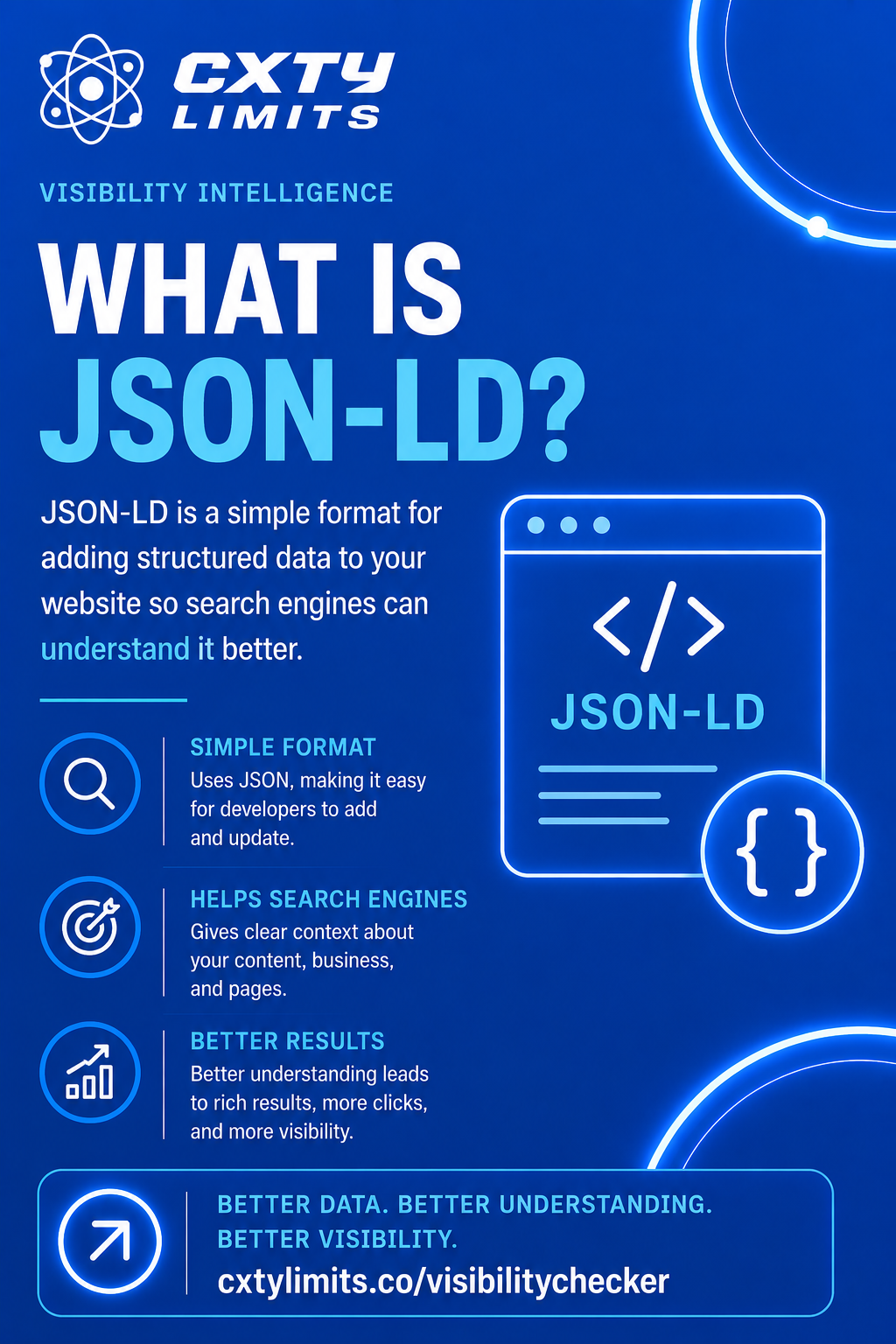
What Is JSON-LD?
JSON-LD is the most common format for adding structured data to websites. Learn how JSON-LD helps search engines understand businesses without changing what visitors see.
Adding structured data to a website doesn't have to change what visitors see.
Instead, it can be added behind the scenes in a format that search engines can easily understand.
The most common format for doing this is JSON-LD.
What is JSON-LD?
JSON-LD stands for JavaScript Object Notation for Linked Data.
It is a structured way to describe information about a webpage or business using clearly labeled data.
Visitors never see it.
Search engines and AI systems read it while crawling your website.
Why search engines recommend it
JSON-LD separates structured data from the visible content on a webpage.
That makes it easier to maintain and reduces the chance of accidentally changing the page layout.
It also allows developers to update structured information without rewriting page content.
What can JSON-LD describe?
Businesses commonly use JSON-LD to identify:
Business name
Address
Phone number
Website
Business category
Services
Hours
Service areas
Social profiles
These attributes help search systems understand exactly what the business represents.
JSON-LD supports entity recognition
JSON-LD does not improve visibility by itself.
Instead, it gives search engines another trustworthy source of structured information.
When JSON-LD matches information found on your website, Maps, directories, and other trusted sources, confidence increases that all references describe the same business.
Keep it accurate
Like every other business signal, JSON-LD should always match your visible website information.
Outdated or incorrect structured data can create confusion just as inconsistent business listings can.
Maintaining accurate information everywhere is far more valuable than simply adding more markup.
Key takeaway
JSON-LD is the preferred format for publishing structured business data on modern websites.
Combined with accurate business information and consistent entity signals, it helps search engines and AI systems understand your business with greater confidence.
Check your business visibility
Use the Visibility Checker to see how consistently your business appears across search engines, Maps, directories, reviews, competitors, and AI-powered discovery.