
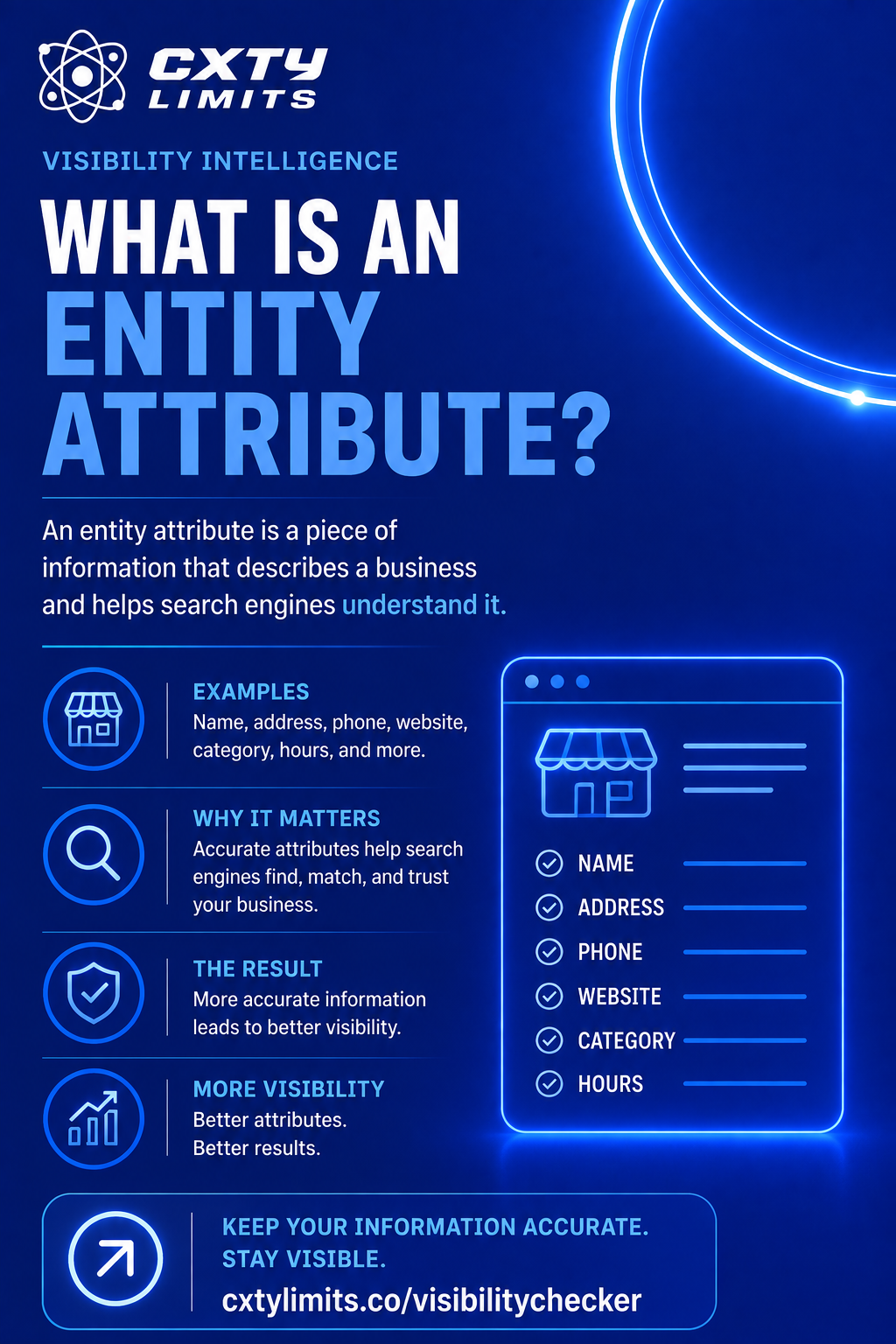
What Is an Entity Attribute?
Every business is made up of attributes such as its name, address, website, services, and categories. Learn how entity attributes help search engines and AI systems recognize businesses more accurately.
Every business can be described by a collection of facts.
Its name.
Its address.
Its phone number.
Its website.
Its services.
Together, these facts are known as entity attributes.
Search engines and AI systems use these attributes to recognize, compare, and understand real-world businesses.
What are entity attributes?
An entity attribute is a characteristic that describes an entity.
For a business, common attributes include:
Business name
Address
Phone number
Website
Business category
Services
Operating hours
Geographic location
Each attribute helps search systems determine exactly which business they are analyzing.
Why attributes matter
No single attribute identifies a business by itself.
Instead, search engines compare many attributes together.
For example:
A matching business name is useful.
A matching address adds confidence.
The same website increases confidence further.
Accurate services and categories strengthen recognition even more.
Together, these attributes create a much clearer digital identity.
Attributes build confidence
Search engines continuously compare information from websites, directories, Maps, reviews, and public references.
When attributes remain accurate across those sources, confidence increases that every record belongs to the same business.
When attributes conflict, recognition becomes more difficult.
AI also depends on attributes
Modern AI systems organize businesses using structured information.
The more accurate your attributes remain, the easier it becomes for AI to summarize your business correctly and answer customer questions with confidence.
Maintaining accurate attributes
Businesses should review their core information regularly.
Good practices include:
Updating business details after changes
Removing duplicate listings
Correcting outdated information
Keeping the company website current
Maintaining consistent categories and services
These habits make it easier for search engines and AI systems to understand your business.
Key takeaway
Entity attributes are the individual pieces of information that describe a business.
Together, they form the digital identity that search engines, Maps, and AI systems use to recognize and understand your business.
Check your visibility
Use the Visibility Checker to discover how consistently your business appears across search engines, Maps, directories, reviews, competitors, and AI-powered discovery.
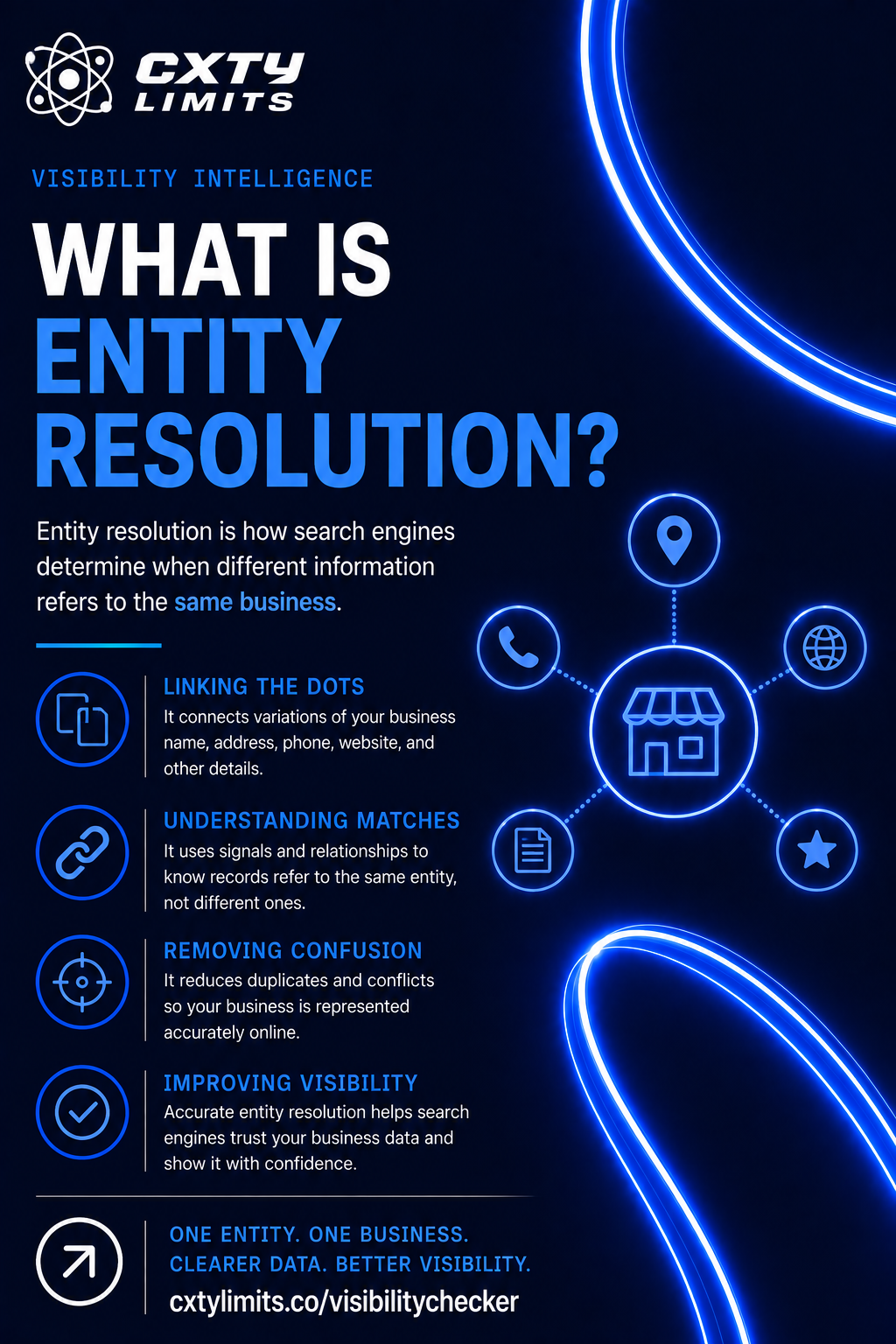
What Is Entity Resolution?
Entity resolution is the process search engines and AI systems use to determine when different pieces of information describe the same real-world business. Learn why it matters for online visibility.
Every business leaves information across the internet.
Your website, Google Business Profile, Maps listings, review sites, directories, news articles, and social profiles all describe your company in different ways.
Search engines must decide whether those records belong to one business—or several.
That process is called entity resolution.
Matching real-world businesses
Entity resolution is the process of comparing information from many sources to determine whether they describe the same real-world entity.
Search systems compare details such as:
Business name
Address
Phone number
Website
Categories
Geographic location
Services
Public references
The more those details agree, the easier it becomes to recognize one business across many sources.
Why it matters
Without entity resolution, search engines would treat every listing as unrelated information.
Instead, they combine trusted signals to build one complete understanding of your business.
This helps produce:
More accurate search results
Better Maps information
Stronger business recognition
More reliable AI-generated answers
Small differences are normal
Businesses are rarely described in exactly the same way everywhere.
One directory may abbreviate a street name.
Another may use a different phone format.
A review site might shorten the company name.
Search engines expect small differences.
The challenge comes when multiple trusted sources contain conflicting or outdated information.
Better information creates stronger confidence
Entity resolution is based on confidence, not perfection.
When accurate information appears consistently across trusted sources, confidence increases that those records describe the same business.
That confidence helps improve how your business is understood across search engines and AI systems.
How businesses can help
Businesses can make entity resolution easier by:
Using one official business name
Keeping contact information current
Updating listings after changes
Removing duplicate profiles
Maintaining a consistent website
These practices help search systems recognize your business more accurately.
Check your visibility
Entity resolution connects information from many different sources into one recognized business identity.
The stronger and more consistent those signals become, the easier it is for search engines, Maps, and AI systems to understand your business correctly. See your business visibility
Use the Visibility Checker to discover how consistently your business appears across search engines, Maps, directories, reviews, competitors, and AI-powered discovery.
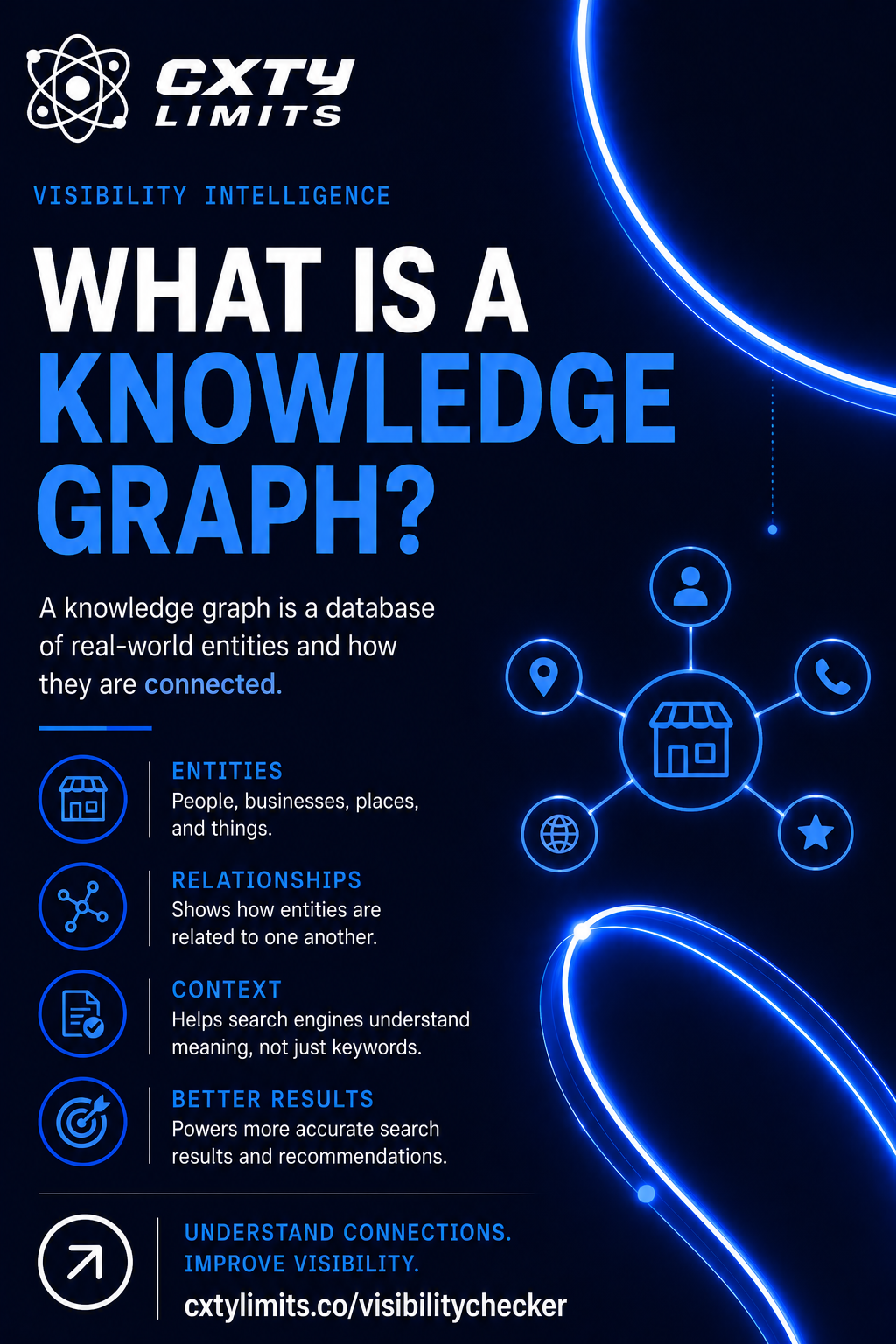
What Is a Knowledge Graph?
A knowledge graph helps search engines connect people, places, businesses, and organizations into real-world entities. Learn how knowledge graphs improve search results, Maps, and AI-generated answers.
A knowledge graph is a system that helps search engines understand how real-world things are connected.
Instead of treating every webpage as isolated information, search engines connect businesses, people, locations, products, and organizations into relationships that describe the real world.
This allows search systems to understand entities—not just keywords.
More than a database
A knowledge graph is not simply a list of businesses.
It stores relationships between entities.
For example, a business may be connected to:
Its website
Physical locations
Phone numbers
Services
Reviews
Industry categories
Social profiles
Owners
Nearby places
Together, those relationships help search engines build a clearer understanding of the business.
Why search engines use knowledge graphs
Search engines collect information from thousands of trusted sources.
As those sources agree, confidence increases that they describe the same business.
That information becomes part of a larger network of connected entities.
This helps search engines answer questions more accurately instead of relying on a single webpage.
Knowledge graphs power modern search
Many search features depend on entity relationships, including:
Local search results
Google Maps
Business information panels
AI-generated answers
Related business suggestions
Voice search
The stronger your business's digital identity, the easier it becomes for these systems to connect your information correctly.
Building stronger connections
Businesses improve their presence in knowledge graphs by maintaining consistent information across the web.
Helpful practices include:
Keeping one official business name
Maintaining accurate contact information
Updating listings after changes
Removing duplicate profiles
Publishing clear information on the company website
These actions help search engines recognize that multiple references belong to one real-world business.
Why it matters
Knowledge graphs help search engines understand businesses rather than simply matching keywords.
When your information is consistent and trustworthy, search engines and AI systems can identify your business with greater confidence and deliver more accurate results to customers.
Key takeaway
A knowledge graph connects information from many trusted sources to build a complete understanding of real-world businesses.
The more consistent your digital information becomes, the easier it is for search engines, Maps, and AI systems to recognize and recommend your business.
See your business visibility
Use the Visibility Checker to discover how consistently your business appears across search engines, Maps, directories, reviews, competitors, and AI-powered discovery.
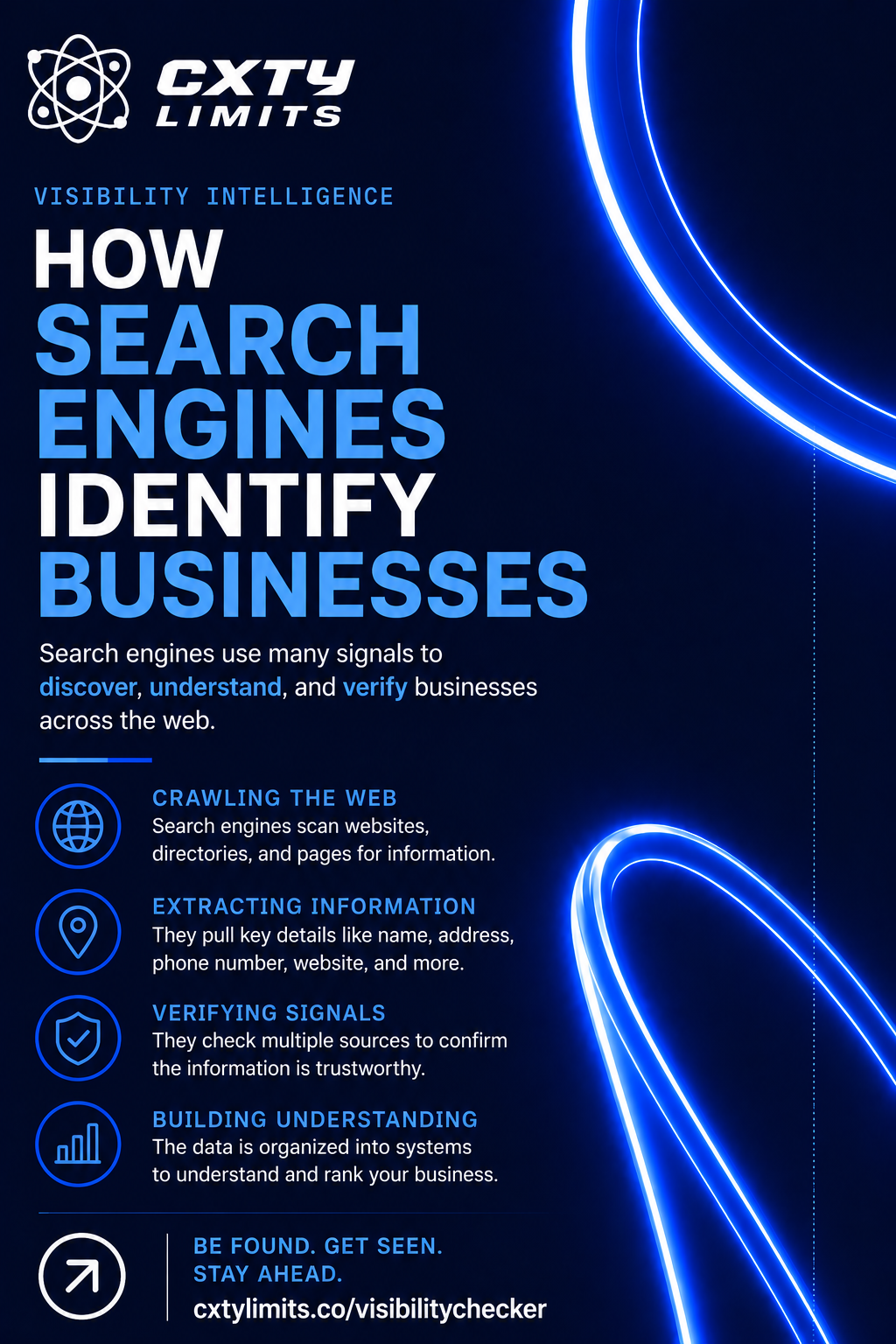
How Search Engines Identify Businesses
Search engines don't identify businesses from a single website. They compare information from many sources to determine whether different mentions refer to the same real-world business.
Search engines do much more than crawl websites.
Their job is to determine whether different pieces of information describe the same real-world business. Every website, directory, review, map listing, and social profile becomes another signal that helps build that understanding.
The more those signals agree, the easier it is for search engines to recognize your business with confidence.
Businesses leave digital footprints
A business appears in many places online.
Examples include:
Company website
Google Business Profile
Google Maps
Apple Maps
Industry directories
Review websites
Social media
News articles
Government records
Each source provides another piece of information that search engines compare.
Matching information together
Search systems don't rely on one source.
Instead, they compare details such as:
Business name
Address
Phone number
Website
Services
Categories
Operating hours
Geographic location
When those details consistently describe the same organization, confidence increases that every reference belongs to one business.
Confidence matters
Search engines rarely make decisions using absolute certainty.
Instead, they calculate confidence.
When multiple trusted sources agree, they become more confident that they understand the business correctly.
When information conflicts, confidence decreases and additional verification may be required.
More than websites
Many people assume rankings depend only on their website.
In reality, search engines continuously compare information across many independent sources.
Even businesses with excellent websites can create confusion if outdated information exists elsewhere online.
That's why maintaining consistent business information across the web is important.
AI uses similar signals
Modern AI search systems also gather information from multiple sources.
Rather than relying on a single webpage, AI models often summarize information after identifying the business across numerous trusted references.
The better your digital information aligns, the easier it becomes for both search engines and AI systems to understand who you are.
Building stronger recognition
Businesses can improve recognition by:
Using one official business name
Maintaining accurate contact information
Updating listings after changes
Removing duplicate profiles
Keeping their website current
Monitoring public references regularly
These habits help create a more complete and trustworthy digital identity.
Key takeaway
Search engines identify businesses by comparing information from many different sources—not by relying on a single website.
The more accurate and consistent those sources remain, the easier it becomes for search engines, Maps, customers, and AI systems to recognize your business correctly.
Check your business visibility
Use the Visibility Checker to see how consistently your business appears across search engines, Maps, directories, reviews, competitors, and AI-powered discovery. The Visibility Checker reveals how a business appears across search, Maps, reviews, websites, competitors, and AI-generated answers.
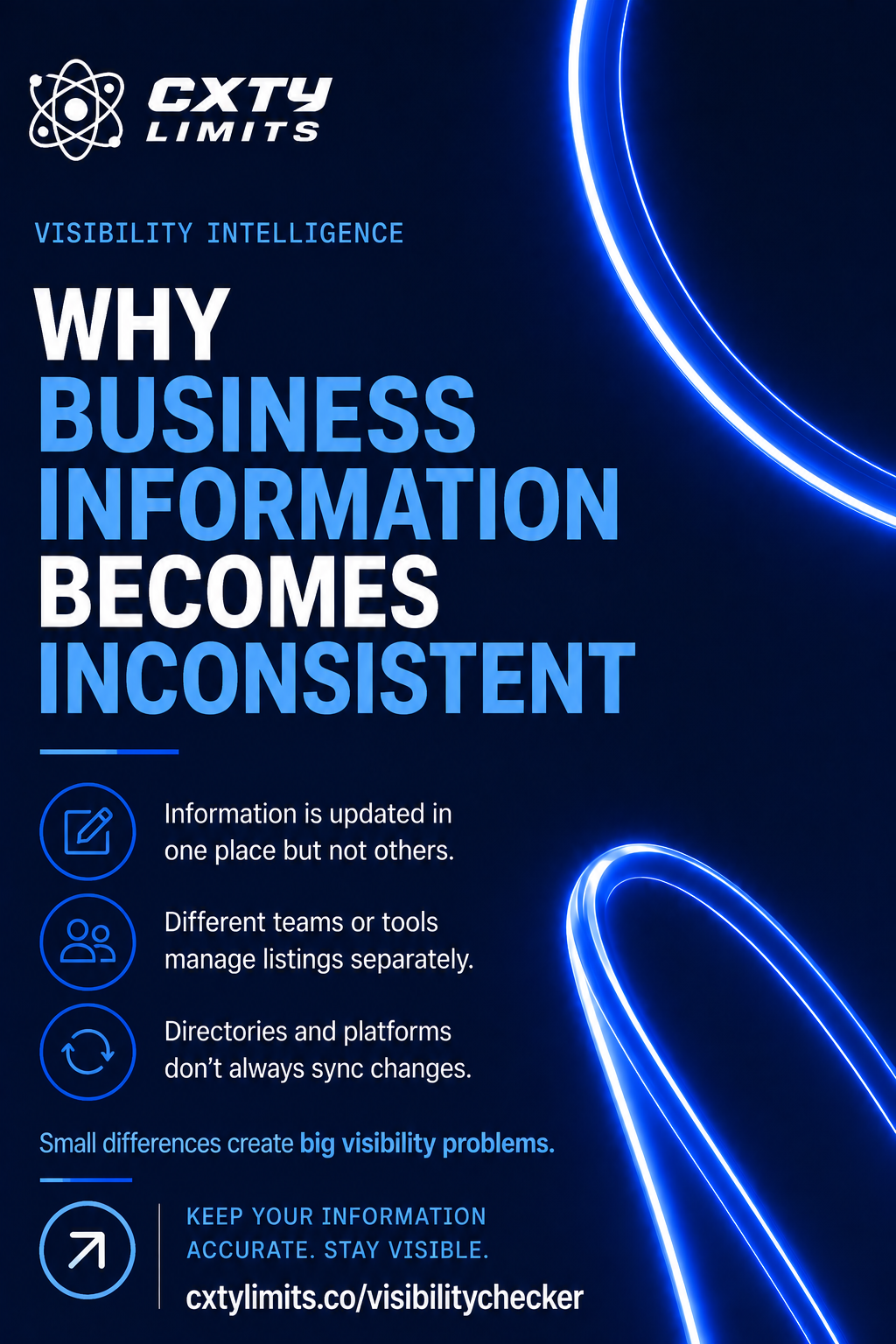
Why Business Information Becomes Inconsistent
Business information changes over time, but outdated websites, directories, profiles, and public references often remain online. Learn why business information becomes inconsistent and how it affects search engines, Maps, and AI systems.
Business information becomes inconsistent when different sources describe the same company in different ways.
Over time, businesses change.
They move offices, update phone numbers, expand service areas, launch new services, or rebrand.
The problem is that many online sources never update.
As old information spreads across websites, directories, Maps, reviews, and public references, search engines and AI systems must decide which version is correct.
Why inconsistency happens
Most inconsistencies are accidental.
Common causes include:
Business name changes
New phone numbers
Office relocations
Expanded service areas
New websites
Duplicate listings
Old directory profiles
Franchise or multi-location growth
Each change creates another opportunity for conflicting information to remain online.
Why it matters
Search engines and AI systems compare information from many sources before identifying a business.
When trusted sources disagree, confidence decreases.
That can affect:
Search visibility
Local discovery
AI-generated answers
Business descriptions
Customer trust
Conflicting information does not automatically remove a business from search results.
It makes the business more difficult to understand.
A simple example
Imagine a plumbing company.
Its website lists a Tampa office.
An old directory still lists Clearwater.
Google Business Profile uses a newer phone number.
A review website still displays the previous one.
Customers may still recognize the company.
Search systems must determine whether all of those records describe the same business.
The more agreement they find, the easier that process becomes.
Inconsistency affects more than Google
Business information appears across many digital environments, including:
Websites
Google Business Profile
Google Maps
Apple Maps
Review platforms
Directories
Industry websites
News articles
AI-generated answers
Outdated information can spread between these sources over time.
How to reduce inconsistency
Businesses should regularly review the information they control.
That includes:
Website details
Contact information
Business descriptions
Service pages
Google Business Profile
Directory listings
Social profiles
The goal is not identical wording everywhere.
It is accurate, consistent information that clearly describes the same business.
To understand why this matters, read What Is Entity Consistency?.
Prevent future problems
Businesses can reduce future inconsistencies by:
Using one official business name
Maintaining one primary website
Updating listings after major changes
Removing duplicate profiles
Reviewing public references regularly
Small updates performed consistently are usually easier than correcting years of outdated information.
Key takeaway
Business information becomes inconsistent because online sources change at different speeds.
The more accurate and consistent those sources remain, the easier it becomes for search engines, Maps, customers, and AI systems to correctly identify and understand the business.
See how your business appears
The Visibility Checker reveals how a business appears across search, Maps, reviews, websites, competitors, and AI-generated answers.
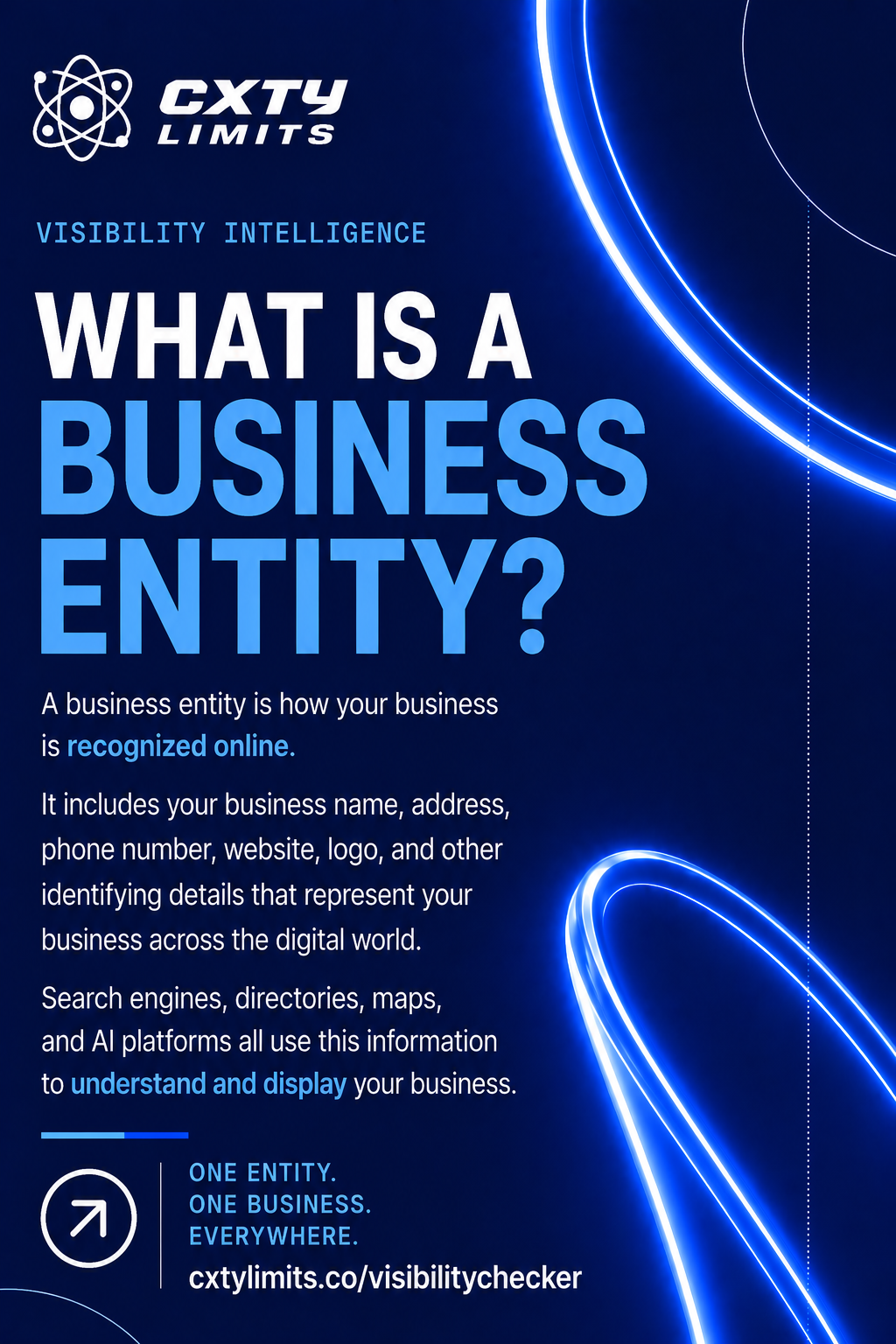
What Is a Business Entity?
A business entity is the digital identity search engines and AI systems use to recognize, understand, and distinguish a company from every other business. Learn how business entities work and why they matter.
A business entity is the digital identity that search engines and AI systems use to recognize, distinguish, and understand a company.
It is more than a website, a Google Business Profile, or a social media account.
A business entity is the collection of information that consistently describes one organization across the web.
Search engines use this information to determine who a business is, what it does, where it operates, and when it should appear in search results or AI-generated answers.
Businesses are more than websites
Years ago, search engines primarily evaluated webpages.
Today they also evaluate the businesses behind those pages.
Instead of asking only, "Is this webpage relevant?"
Modern systems also ask:
Which business does this represent?
Is it the same company mentioned elsewhere?
Is the information consistent?
Can this business be trusted?
That is why entity recognition has become an important part of online visibility.
How search engines identify a business
Search engines compare information from many sources, including:
Business websites
Google Business Profile
Maps
Reviews
Directories
News articles
Industry websites
Public records
Social profiles
When those sources consistently describe the same business, confidence increases.
When they conflict, understanding becomes more difficult.
To learn why consistency matters, read What Is Entity Consistency?.
What makes an entity stronger?
A stronger business entity usually has:
One consistent business name
One official website
Accurate contact information
Clear service descriptions
Consistent locations
Credible third-party references
Recent customer reviews
Reliable business categories
None of these guarantee rankings.
Together, they help search engines understand the business more accurately.
Business entities and AI
AI systems also rely on business entities.
Before an AI system recommends a company, it first has to determine which company it is describing.
If multiple businesses share similar names or conflicting information exists online, the generated answer may become incomplete or inaccurate.
For a deeper explanation, read How ChatGPT Sees a Business.
Common misconceptions
"My website is my business."
Your website is one source of information.
It is not the business entity itself.
"Google knows who I am."
Only if the available information clearly identifies your company.
Conflicting names, outdated listings, and inconsistent profiles can reduce confidence.
"Small businesses don't have entities."
Every business has an entity.
The difference is how clearly that entity is represented across trusted sources.
How businesses improve entity recognition
Businesses can strengthen their digital identity by:
Using one official business name
Keeping profiles accurate
Publishing detailed service pages
Maintaining consistent contact information
Earning authentic reviews
Building credible references
Removing outdated listings
The objective is simple:
Make it easy for people and systems to recognize the same business everywhere it appears.
Key takeaway
A business entity is the digital identity search engines and AI systems use to recognize a company.
The clearer and more consistent that identity becomes, the easier it is for the business to be found, understood, compared, and recommended.
The clearer and more consistent that identity becomes, the easier it is for the business to be found, understood, compared, and recommended.
See how your business appears
The Visibility Checker reveals how a business appears across search, Maps, reviews, websites, competitors, and AI-generated answers.
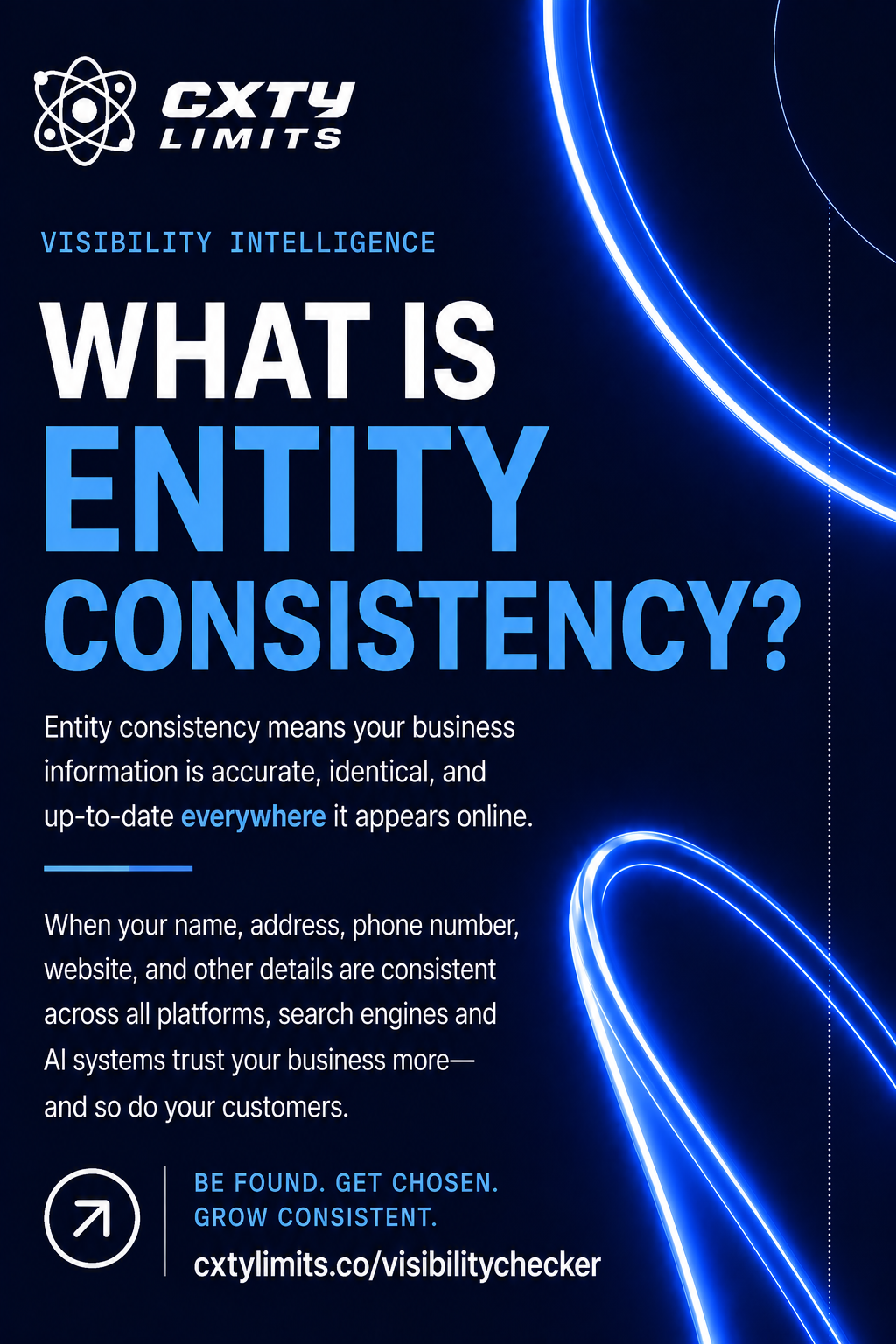
What Is Entity Consistency?
Entity consistency is the practice of presenting the same accurate business information across your website, search engines, Maps, directories, reviews, and AI systems so they can confidently identify your business.
Entity consistency means presenting the same accurate information about your business everywhere it appears online.
Your website, Google Business Profile, directories, review sites, social profiles, and third-party mentions should all describe the same business in a consistent way.
When they do, search engines and AI systems can identify your business with greater confidence.
When they don't, confusion increases.
Why it matters
Modern search engines no longer evaluate only webpages.
They also evaluate businesses as entities.
That means systems compare information from many different sources before deciding what a business is, where it operates, and which searches it should appear for.
To understand how AI builds that picture, read How ChatGPT Sees a Business.
What should stay consistent?
Important business information includes:
Business name
Website
Phone number
Address
Service areas
Business categories
Primary services
Brand description
Hours
Leadership information
Minor wording differences are normal.
Major conflicts create uncertainty.
An example
Imagine a landscaping company.
Its website says:
Green Valley Landscaping
Google Business Profile lists:
Green Valley Lawn Care
A directory lists:
Green Valley Outdoor Services
Another website still shows an old phone number.
A local article mentions a former location.
People may recognize these as the same business.
Search engines and AI systems must determine whether they actually are.
Every inconsistency makes that process more difficult.
Entity consistency improves trust
Consistent information helps systems answer questions like:
Is this the same business?
Which website is official?
Which phone number is correct?
Which services does the company provide?
Which city does it serve?
The more agreement there is across trusted sources, the easier those questions become.
Consistency does not guarantee higher rankings.
It creates a stronger information environment.
Entity consistency and AI
AI systems often combine information from multiple sources before generating an answer.
If those sources agree, the response is more likely to be accurate.
If they conflict, the answer may become incomplete or uncertain.
That is one reason entity consistency has become increasingly important as AI search grows.
For a broader explanation, see What Is AI Search?.
Common causes of inconsistency
Businesses often become inconsistent after:
Rebranding
Moving locations
Changing phone numbers
Expanding service areas
Launching new services
Creating duplicate listings
Leaving old directory profiles online
Over time, outdated information spreads across the web.
Without regular maintenance, those inconsistencies accumulate.
How to improve entity consistency
Businesses can strengthen consistency by:
Keeping their website current
Updating Google Business Profile
Correcting directory listings
Using one official business name
Publishing clear service pages
Reviewing third-party references
Removing outdated information
The objective is not to make every sentence identical.
It is to ensure every source describes the same business.
Key takeaway
Entity consistency helps search engines, Maps, and AI systems confidently recognize your business.
The more consistently your company is represented across trusted sources, the easier it becomes to understand, evaluate, and recommend.
See how your business appears
The Visibility Checker reveals how a business appears across search, Maps, reviews, websites, competitors, and AI-generated answers.

How ChatGPT Sees a Business
ChatGPT does not rely on one permanent business profile. Learn how websites, public references, web retrieval, connected information, and query context can shape what it says about a company.
How ChatGPT Sees a Business
ChatGPT does not rely on one permanent business profile. It builds an answer from the information available in that specific interaction.
That may include model knowledge, current web sources, the company’s website, public references, connected information, and the way the question was asked.
This is why two people can ask about the same business and receive different answers.
One response may describe the company clearly. Another may be vague. A third may not mention it at all.
That does not necessarily mean the business moved up or down a fixed ChatGPT ranking.
It means the answer was assembled under different conditions.
To understand the broader system behind this, start with What Is AI Search?.
ChatGPT does not use one fixed business profile
Google Business Profile has a defined listing.
A website has specific pages.
A directory has a database record.
ChatGPT is different.
It does not simply open one permanent company card. It generates a response from the information available for the question being answered.
Five main layers can shape that response.
1. Business identity
Before ChatGPT can describe a company correctly, it has to distinguish that company from other entities.
That can be harder than it sounds.
A business may share its name with another company, product, person, or location. It may also appear online under several variations of its name.
Names, websites, founders, locations, services, profiles, and external references all help establish which business is being discussed.
Clear identity reduces confusion.
2. First-party information
The official website is usually the strongest source a business directly controls.
It can explain:
What the company does
Who it serves
Which services it offers
Where it operates
Who leads it
How customers can contact it
Why it should be trusted
A vague website creates a vague source.
If a homepage only says the company provides “innovative solutions,” neither a customer nor a machine can easily determine what the business actually does.
Clear, specific language gives ChatGPT and other systems better material to work with.
The website cannot control the final answer. It can make the business easier to understand.
3. Public evidence
A company also exists through the information other sources publish about it.
That may include:
Reviews
Directories
News articles
Social profiles
Partner pages
Industry associations
Interviews
Case studies
Customer discussions
These sources can reinforce the official description.
They can also conflict with it.
Imagine an HVAC company whose website says it serves Tampa, while an old directory lists Clearwater and a review platform classifies it as appliance repair.
ChatGPT may encounter mixed evidence.
The result could be accurate, incomplete, outdated, or uncertain.
4. Retrieval context
ChatGPT can search the web when current information would help answer a question.
When search is used, the system may retrieve information about:
The business name
Current services
Locations
Reviews
Recent news
Products
Competitors
Evidence supporting a recommendation
The sources selected for one question may differ from those selected for another.
“Tell me about this company” is not the same task as “Which companies near me offer this service and have strong recent reviews?”
Different questions can produce different searches and different answers.
5. Query and conversation context
ChatGPT answers the full request, not only the business name.
The response may change based on:
Wording
Location
Budget
Service requirements
Conversation history
Whether search is active
Whether the user asks for a description, comparison, or recommendation
For example:
What does CXTY Limits do?
asks for a description.
Is CXTY Limits a good fit for a local business?
asks for evaluation.
Which companies provide white-label visibility audits?
asks for comparison.
The business has not changed.
The task has.
Model knowledge and current web information are different
ChatGPT may answer from information represented during training, or it may use current information retrieved from the web.
Model knowledge can be incomplete, outdated, or limited for smaller businesses.
Web retrieval can improve freshness, but it does not guarantee completeness or accuracy.
The system still has to decide what to search, which sources to use, and how to summarize them.
A current page can be wrong. A retrieved source can be outdated. A generated answer can misunderstand the evidence.
Known, mentioned, cited, and recommended are not the same
Businesses often ask whether ChatGPT “knows” them.
That can mean several different things.
Recognized: ChatGPT can identify the business when asked directly.
Mentioned: The business appears in an answer.
Cited: A page connected to the business appears as a source.
Compared: The business is evaluated beside alternatives.
Recommended: The business is presented as a possible fit for a specific need.
These outcomes are not interchangeable.
A company can be recognized without being recommended. It can be cited without being prominently mentioned. It can be recommended for one query and excluded from another.
This is why ChatGPT visibility should not be reduced to one supposed ranking.
What a business can influence
A business cannot directly control ChatGPT’s final answer.
It can improve the information environment around the company by:
Clearly explaining its services
Keeping public profiles current
Using consistent business names
Creating specific service pages
Publishing credible proof
Making important information easy to access
Earning relevant reviews and external references
These actions improve clarity and retrievability.
They do not guarantee a mention, citation, or recommendation.
The goal is to make the business easier to identify, understand, verify, and consider.
Key takeaway
ChatGPT does not see a business through one permanent profile.
It builds a context-dependent representation from the information available in that interaction.
That may include model knowledge, current web retrieval, the official website, public references, connected sources, and the wording of the request.
Businesses cannot control the final answer.
They can improve the clarity, consistency, credibility, and accessibility of the information from which answers may be formed.
See how your business appears
The Visibility Engine helps reveal how a business appears across search, Maps, reviews, websites, and AI-generated answers.