
What Is Structured Business Data?
Structured business data organizes information into a format that search engines and AI systems can understand more easily. Learn why structured data strengthens business recognition and online visibility.
Every business publishes information online.
Your website lists your services.
Your contact page shows your phone number.
Your Google Business Profile contains your address.
To people, this information is easy to understand.
Search engines, however, work best when that information follows a consistent structure.
That's where structured business data becomes important.
What is structured business data?
Structured business data is information organized in a predictable format so computers can interpret it more accurately.
Instead of simply reading text, search engines can identify specific business details like:
Business name
Address
Phone number
Website
Services
Categories
Hours
Geographic location
This makes it easier to understand exactly what a business represents.
Why structure matters
Search engines compare information from many different sources.
When business information follows consistent patterns, systems can match records more confidently and reduce ambiguity.
Structured information also helps AI systems summarize businesses more accurately.
More than your website
Structured business data extends beyond one webpage.
Search engines compare information across:
Company websites
Business directories
Google Business Profile
Maps
Review platforms
Industry listings
Public records
Consistent structure across these sources strengthens recognition.
Building stronger digital identities
Accurate structured data supports:
Entity recognition
Knowledge graphs
Local search
AI-generated answers
Business discovery
The goal is not simply ranking higher—it is making your business easier for search systems to understand.
Why it matters
Businesses with organized, consistent information create stronger digital identities.
That improves confidence for search engines, Maps, and AI systems while making it easier for customers to find accurate information.
Key takeaway
Structured business data organizes business information into formats that search engines can interpret with greater confidence.
The better your information is organized and maintained, the stronger your online visibility becomes.
Check your visibility
Use the Visibility Checker to discover how consistently your business appears across search engines, Maps, directories, reviews, competitors, and AI-powered discovery.
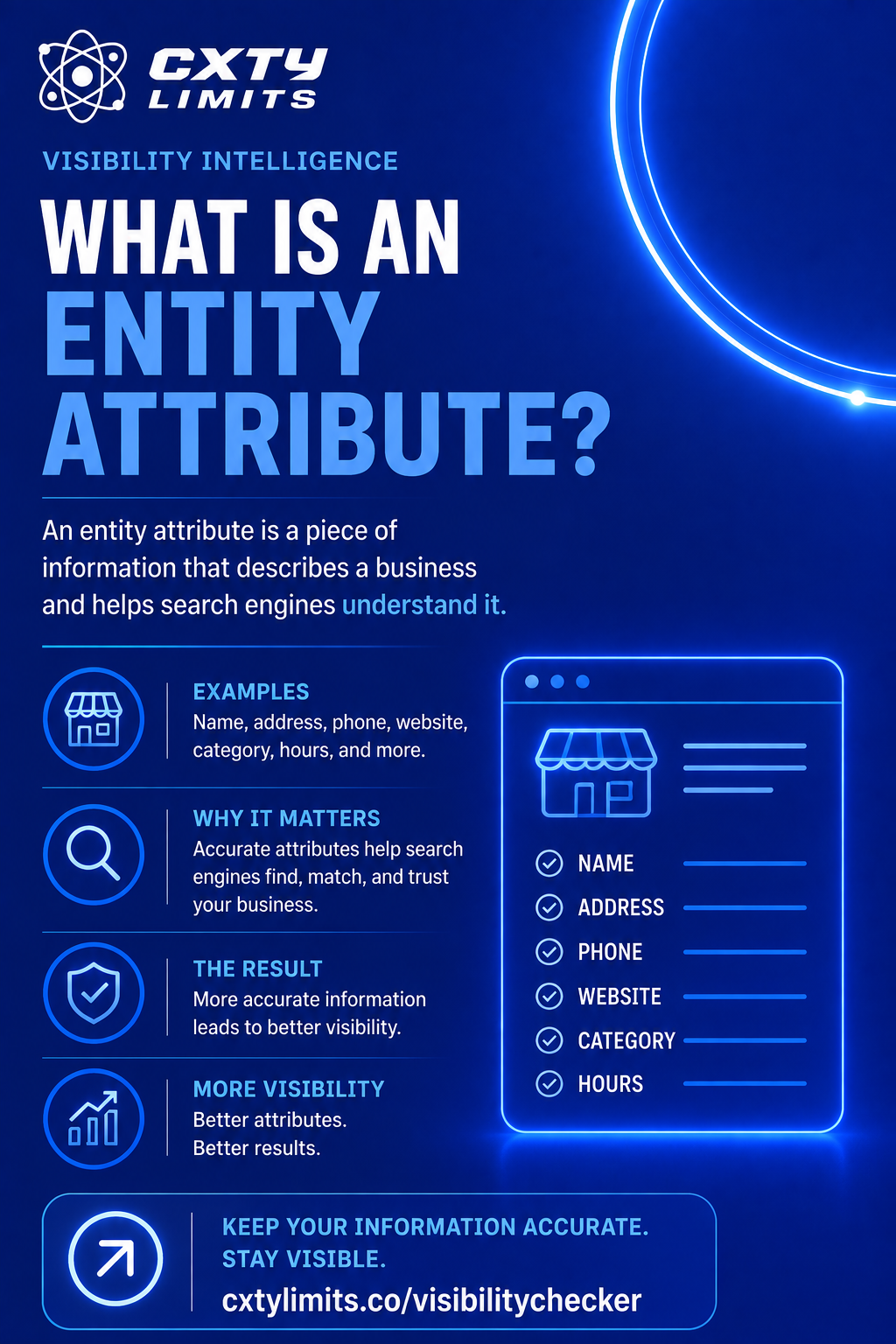
What Is an Entity Attribute?
Every business is made up of attributes such as its name, address, website, services, and categories. Learn how entity attributes help search engines and AI systems recognize businesses more accurately.
Every business can be described by a collection of facts.
Its name.
Its address.
Its phone number.
Its website.
Its services.
Together, these facts are known as entity attributes.
Search engines and AI systems use these attributes to recognize, compare, and understand real-world businesses.
What are entity attributes?
An entity attribute is a characteristic that describes an entity.
For a business, common attributes include:
Business name
Address
Phone number
Website
Business category
Services
Operating hours
Geographic location
Each attribute helps search systems determine exactly which business they are analyzing.
Why attributes matter
No single attribute identifies a business by itself.
Instead, search engines compare many attributes together.
For example:
A matching business name is useful.
A matching address adds confidence.
The same website increases confidence further.
Accurate services and categories strengthen recognition even more.
Together, these attributes create a much clearer digital identity.
Attributes build confidence
Search engines continuously compare information from websites, directories, Maps, reviews, and public references.
When attributes remain accurate across those sources, confidence increases that every record belongs to the same business.
When attributes conflict, recognition becomes more difficult.
AI also depends on attributes
Modern AI systems organize businesses using structured information.
The more accurate your attributes remain, the easier it becomes for AI to summarize your business correctly and answer customer questions with confidence.
Maintaining accurate attributes
Businesses should review their core information regularly.
Good practices include:
Updating business details after changes
Removing duplicate listings
Correcting outdated information
Keeping the company website current
Maintaining consistent categories and services
These habits make it easier for search engines and AI systems to understand your business.
Key takeaway
Entity attributes are the individual pieces of information that describe a business.
Together, they form the digital identity that search engines, Maps, and AI systems use to recognize and understand your business.
Check your visibility
Use the Visibility Checker to discover how consistently your business appears across search engines, Maps, directories, reviews, competitors, and AI-powered discovery.
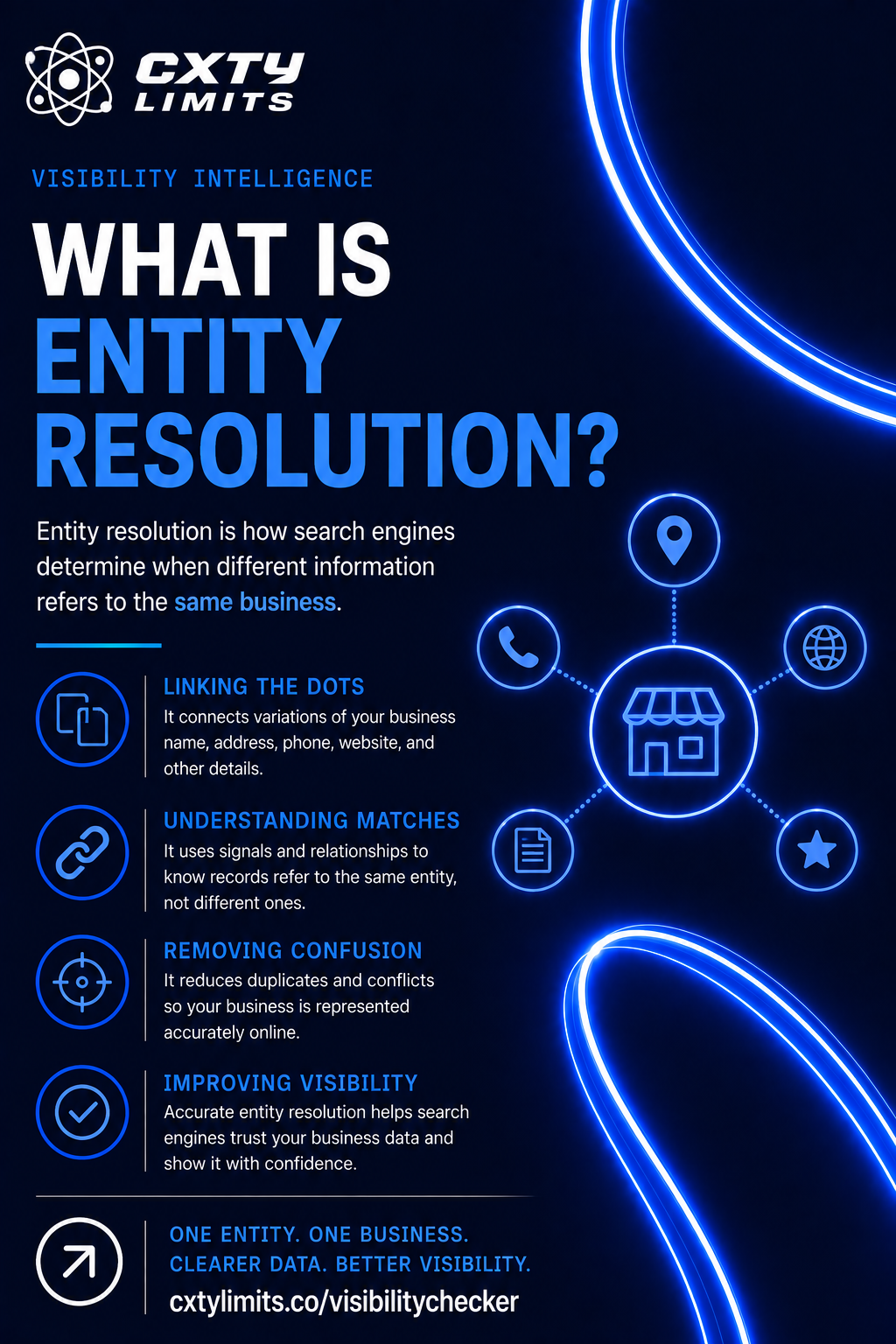
What Is Entity Resolution?
Entity resolution is the process search engines and AI systems use to determine when different pieces of information describe the same real-world business. Learn why it matters for online visibility.
Every business leaves information across the internet.
Your website, Google Business Profile, Maps listings, review sites, directories, news articles, and social profiles all describe your company in different ways.
Search engines must decide whether those records belong to one business—or several.
That process is called entity resolution.
Matching real-world businesses
Entity resolution is the process of comparing information from many sources to determine whether they describe the same real-world entity.
Search systems compare details such as:
Business name
Address
Phone number
Website
Categories
Geographic location
Services
Public references
The more those details agree, the easier it becomes to recognize one business across many sources.
Why it matters
Without entity resolution, search engines would treat every listing as unrelated information.
Instead, they combine trusted signals to build one complete understanding of your business.
This helps produce:
More accurate search results
Better Maps information
Stronger business recognition
More reliable AI-generated answers
Small differences are normal
Businesses are rarely described in exactly the same way everywhere.
One directory may abbreviate a street name.
Another may use a different phone format.
A review site might shorten the company name.
Search engines expect small differences.
The challenge comes when multiple trusted sources contain conflicting or outdated information.
Better information creates stronger confidence
Entity resolution is based on confidence, not perfection.
When accurate information appears consistently across trusted sources, confidence increases that those records describe the same business.
That confidence helps improve how your business is understood across search engines and AI systems.
How businesses can help
Businesses can make entity resolution easier by:
Using one official business name
Keeping contact information current
Updating listings after changes
Removing duplicate profiles
Maintaining a consistent website
These practices help search systems recognize your business more accurately.
Check your visibility
Entity resolution connects information from many different sources into one recognized business identity.
The stronger and more consistent those signals become, the easier it is for search engines, Maps, and AI systems to understand your business correctly. See your business visibility
Use the Visibility Checker to discover how consistently your business appears across search engines, Maps, directories, reviews, competitors, and AI-powered discovery.
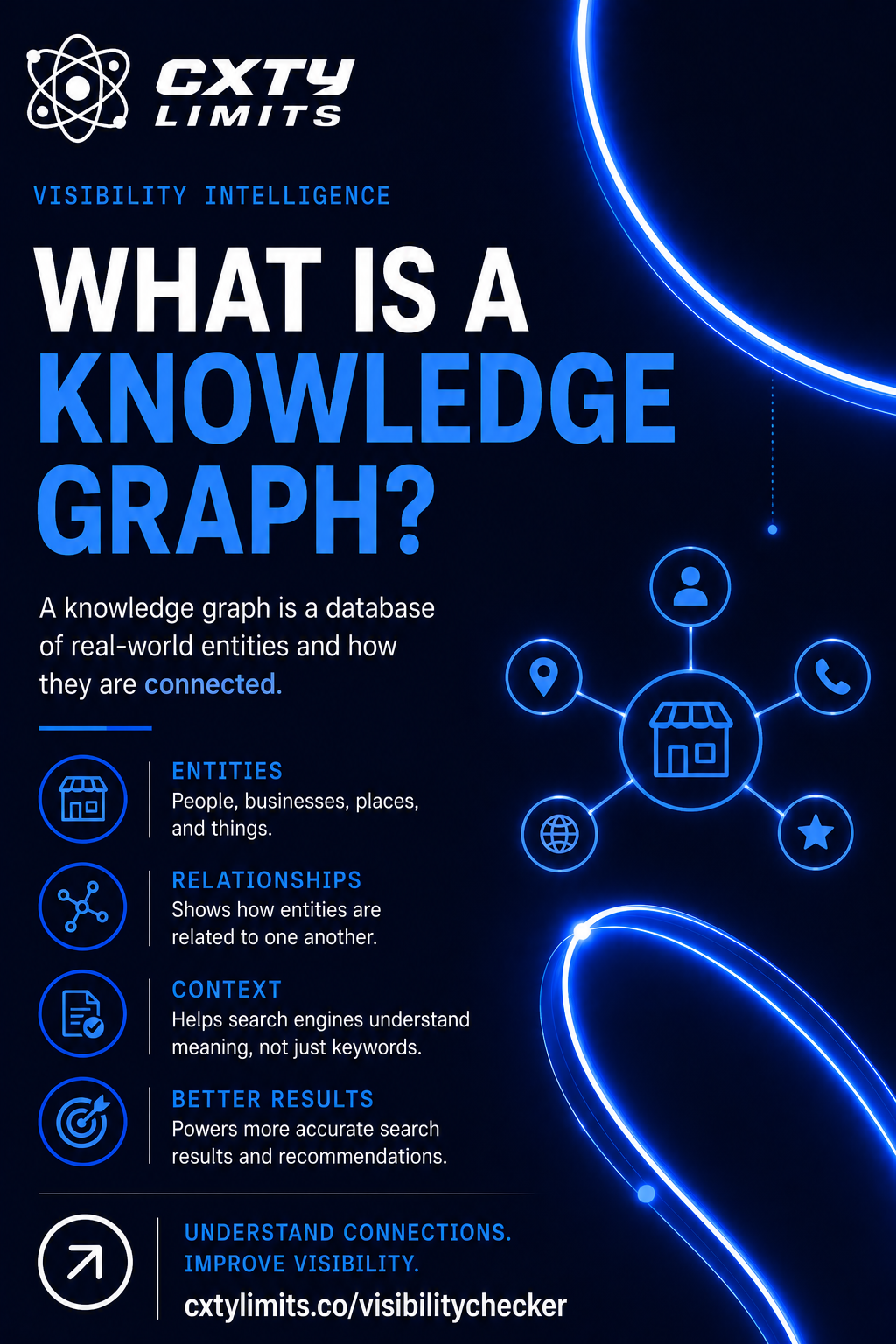
What Is a Knowledge Graph?
A knowledge graph helps search engines connect people, places, businesses, and organizations into real-world entities. Learn how knowledge graphs improve search results, Maps, and AI-generated answers.
A knowledge graph is a system that helps search engines understand how real-world things are connected.
Instead of treating every webpage as isolated information, search engines connect businesses, people, locations, products, and organizations into relationships that describe the real world.
This allows search systems to understand entities—not just keywords.
More than a database
A knowledge graph is not simply a list of businesses.
It stores relationships between entities.
For example, a business may be connected to:
Its website
Physical locations
Phone numbers
Services
Reviews
Industry categories
Social profiles
Owners
Nearby places
Together, those relationships help search engines build a clearer understanding of the business.
Why search engines use knowledge graphs
Search engines collect information from thousands of trusted sources.
As those sources agree, confidence increases that they describe the same business.
That information becomes part of a larger network of connected entities.
This helps search engines answer questions more accurately instead of relying on a single webpage.
Knowledge graphs power modern search
Many search features depend on entity relationships, including:
Local search results
Google Maps
Business information panels
AI-generated answers
Related business suggestions
Voice search
The stronger your business's digital identity, the easier it becomes for these systems to connect your information correctly.
Building stronger connections
Businesses improve their presence in knowledge graphs by maintaining consistent information across the web.
Helpful practices include:
Keeping one official business name
Maintaining accurate contact information
Updating listings after changes
Removing duplicate profiles
Publishing clear information on the company website
These actions help search engines recognize that multiple references belong to one real-world business.
Why it matters
Knowledge graphs help search engines understand businesses rather than simply matching keywords.
When your information is consistent and trustworthy, search engines and AI systems can identify your business with greater confidence and deliver more accurate results to customers.
Key takeaway
A knowledge graph connects information from many trusted sources to build a complete understanding of real-world businesses.
The more consistent your digital information becomes, the easier it is for search engines, Maps, and AI systems to recognize and recommend your business.
See your business visibility
Use the Visibility Checker to discover how consistently your business appears across search engines, Maps, directories, reviews, competitors, and AI-powered discovery.
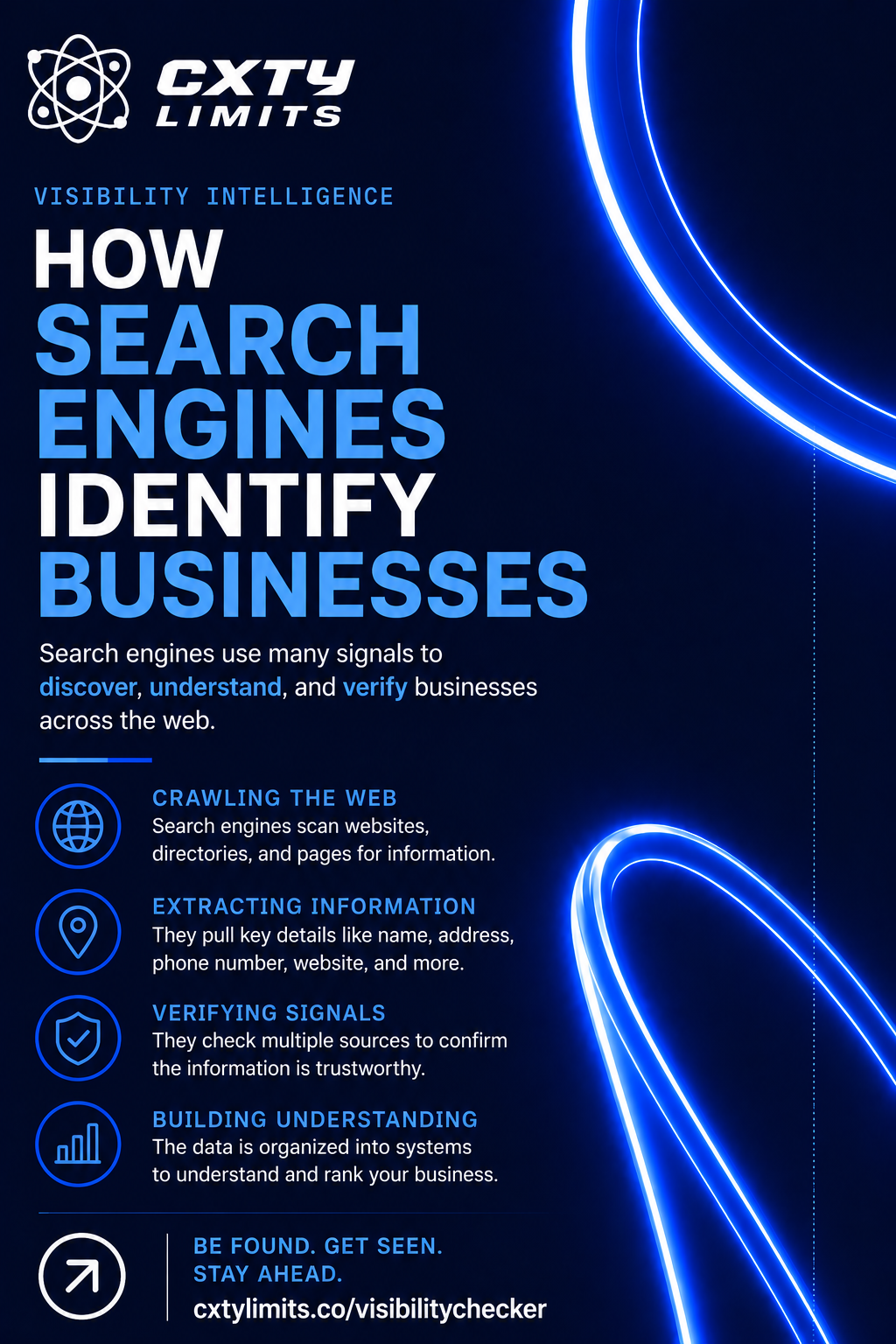
How Search Engines Identify Businesses
Search engines don't identify businesses from a single website. They compare information from many sources to determine whether different mentions refer to the same real-world business.
Search engines do much more than crawl websites.
Their job is to determine whether different pieces of information describe the same real-world business. Every website, directory, review, map listing, and social profile becomes another signal that helps build that understanding.
The more those signals agree, the easier it is for search engines to recognize your business with confidence.
Businesses leave digital footprints
A business appears in many places online.
Examples include:
Company website
Google Business Profile
Google Maps
Apple Maps
Industry directories
Review websites
Social media
News articles
Government records
Each source provides another piece of information that search engines compare.
Matching information together
Search systems don't rely on one source.
Instead, they compare details such as:
Business name
Address
Phone number
Website
Services
Categories
Operating hours
Geographic location
When those details consistently describe the same organization, confidence increases that every reference belongs to one business.
Confidence matters
Search engines rarely make decisions using absolute certainty.
Instead, they calculate confidence.
When multiple trusted sources agree, they become more confident that they understand the business correctly.
When information conflicts, confidence decreases and additional verification may be required.
More than websites
Many people assume rankings depend only on their website.
In reality, search engines continuously compare information across many independent sources.
Even businesses with excellent websites can create confusion if outdated information exists elsewhere online.
That's why maintaining consistent business information across the web is important.
AI uses similar signals
Modern AI search systems also gather information from multiple sources.
Rather than relying on a single webpage, AI models often summarize information after identifying the business across numerous trusted references.
The better your digital information aligns, the easier it becomes for both search engines and AI systems to understand who you are.
Building stronger recognition
Businesses can improve recognition by:
Using one official business name
Maintaining accurate contact information
Updating listings after changes
Removing duplicate profiles
Keeping their website current
Monitoring public references regularly
These habits help create a more complete and trustworthy digital identity.
Key takeaway
Search engines identify businesses by comparing information from many different sources—not by relying on a single website.
The more accurate and consistent those sources remain, the easier it becomes for search engines, Maps, customers, and AI systems to recognize your business correctly.
Check your business visibility
Use the Visibility Checker to see how consistently your business appears across search engines, Maps, directories, reviews, competitors, and AI-powered discovery. The Visibility Checker reveals how a business appears across search, Maps, reviews, websites, competitors, and AI-generated answers.
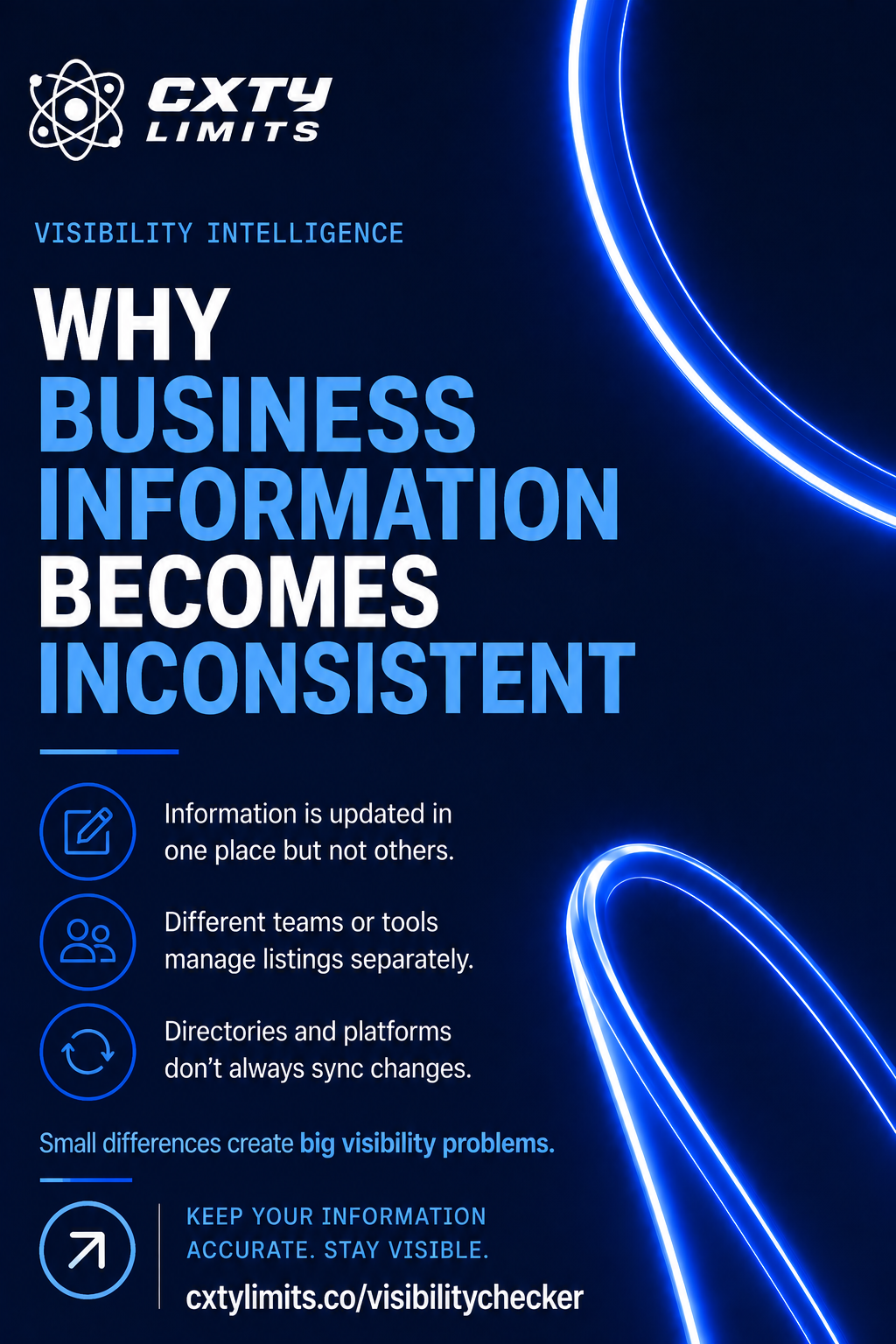
Why Business Information Becomes Inconsistent
Business information changes over time, but outdated websites, directories, profiles, and public references often remain online. Learn why business information becomes inconsistent and how it affects search engines, Maps, and AI systems.
Business information becomes inconsistent when different sources describe the same company in different ways.
Over time, businesses change.
They move offices, update phone numbers, expand service areas, launch new services, or rebrand.
The problem is that many online sources never update.
As old information spreads across websites, directories, Maps, reviews, and public references, search engines and AI systems must decide which version is correct.
Why inconsistency happens
Most inconsistencies are accidental.
Common causes include:
Business name changes
New phone numbers
Office relocations
Expanded service areas
New websites
Duplicate listings
Old directory profiles
Franchise or multi-location growth
Each change creates another opportunity for conflicting information to remain online.
Why it matters
Search engines and AI systems compare information from many sources before identifying a business.
When trusted sources disagree, confidence decreases.
That can affect:
Search visibility
Local discovery
AI-generated answers
Business descriptions
Customer trust
Conflicting information does not automatically remove a business from search results.
It makes the business more difficult to understand.
A simple example
Imagine a plumbing company.
Its website lists a Tampa office.
An old directory still lists Clearwater.
Google Business Profile uses a newer phone number.
A review website still displays the previous one.
Customers may still recognize the company.
Search systems must determine whether all of those records describe the same business.
The more agreement they find, the easier that process becomes.
Inconsistency affects more than Google
Business information appears across many digital environments, including:
Websites
Google Business Profile
Google Maps
Apple Maps
Review platforms
Directories
Industry websites
News articles
AI-generated answers
Outdated information can spread between these sources over time.
How to reduce inconsistency
Businesses should regularly review the information they control.
That includes:
Website details
Contact information
Business descriptions
Service pages
Google Business Profile
Directory listings
Social profiles
The goal is not identical wording everywhere.
It is accurate, consistent information that clearly describes the same business.
To understand why this matters, read What Is Entity Consistency?.
Prevent future problems
Businesses can reduce future inconsistencies by:
Using one official business name
Maintaining one primary website
Updating listings after major changes
Removing duplicate profiles
Reviewing public references regularly
Small updates performed consistently are usually easier than correcting years of outdated information.
Key takeaway
Business information becomes inconsistent because online sources change at different speeds.
The more accurate and consistent those sources remain, the easier it becomes for search engines, Maps, customers, and AI systems to correctly identify and understand the business.
See how your business appears
The Visibility Checker reveals how a business appears across search, Maps, reviews, websites, competitors, and AI-generated answers.